Prof Samraat Pawar visits the lab for the Biomathematics Colloquium
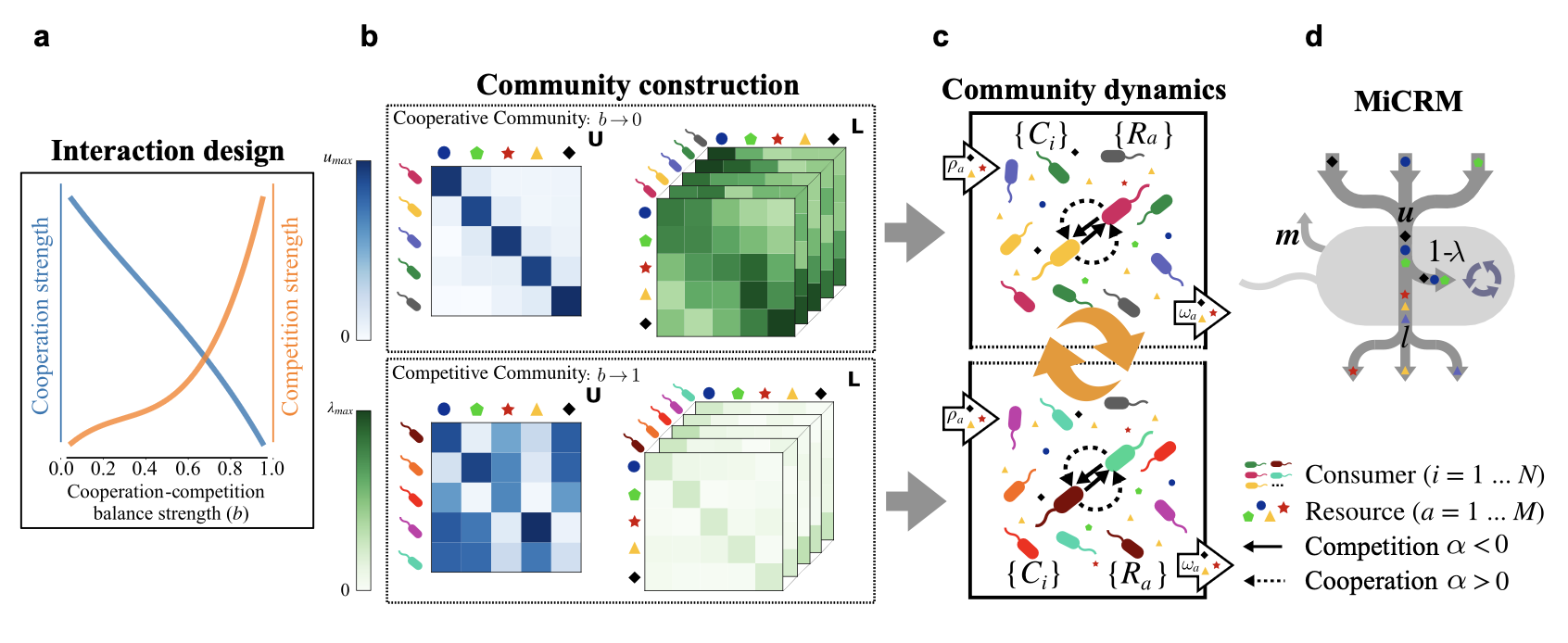
Yesterday we had the pleasure to host Samraat, who visited us from Imperial College London to share his latest research on the coalescence of microbial communities with us at the Biomathematics Colloquium.
His talk, entitled Structural complementarity maximises feasibility and stability in microbial community coalescence summarised recent theoretical work using the Microbial Consumer-Resource Model MiCRM to investigate the possibility of predicting the composition and functionality of microbial communities that result from the coalescence of different assemblages. These assemblages may differ in the extent to which they harbour different interaction types from purely competitive to purely mutualistic communities. The composition of these interactions in parent communities then determines the outcome of the coalescence event and makes the final community predictable.
This theoretical work has many similarities with recent studies in our lab looking into the dynamics of microbial communities and has made us think about potential applications of our current work. These similarities and overlapping research interests yielded very interesting discussions afterwards that Samraat and I hope to keep alive by developing future joint collaborations and projects.
We also discussed potential new avenues with Jooyoung within the framework of her PhD project and how to potentially use a version of the MiCRM to increase the predictability of the role of microbial communities on the yield of red body in Nannochloropsis oceanica.
We ended the day at the pub for a pint and a nice meal! All in all a very interesting and productive visit. Thanks Samraat!
Picture credit: Zhu et al. (2026) bioRxiv